Showing posts with label Fine Art. Show all posts

Saturday, 21 March 2015

Painting Workshop//Finished Piece


This is the finished product of my 6 week painting workshop.
I am very pleased with the painting; I think the piece works well as a whole, and the colours I achieved were very successful.

Thursday, 26 February 2015

Workshop//Painting


In this weeks workshop I worked over the original figure that I started last week, but in stronger colours, with stronger emphasis on the textures and effects made by the paint. I concentrated more on mixing the right colours that will show through on the final piece, and thought a lot about which colours worked best together. I also worked a lot with which textures I could make out of the oil paint and which ones would work best on which parts of the painting. Last week was about simply marking out the figure with colours as guidelines, but this week was much more about conscious decision making.

Thursday, 19 February 2015

Workshop//Painting

This week in my painting workshop I started on my large scale oil painting on canvas. It was a challenge, but I feel like it was successful as a starting point and will help me to achieve an interesting final piece.
I started off by marking out the basic shape of the figure and the background in a yellowy colour,
and then started blocking in the background.

After I had blocked in the background colour, I added the starting colours of the figure.
These aren't exactly the colours I wanted to achieve as we only had a limited range of colours, so
I will be working over/with these. 

Wednesday, 11 February 2015

Paintings//Sheffield Cityscape

During my assessment in January, I had very positive feedback about this painting. It isn't in a style I would usually use, and it is done in acrylic paints, using biro, so I didn't feel too great about it; it felt very much like the kind of work I would have produced at A-Level. However my assessment tutors told me that I should continue experimenting with this style and keep producing this kind of work, because it felt more like the kind of atmosphere of Sheffield than my other paintings did. 

I have continued to produce this kind of work, using acrylic paints and pen, of photos I have taken from Park Hill of Sheffield's cityscape. I am still not feeling that comfortable with painting in this style, it is a much longer process than other paintings I have produced, but the colours and style achieved portray a better sense of Sheffield as a city.


I have also tried using just blacks, whites and greys, and continuing to use pen.

I have also started to do pencil drawings in a similar style to the paintings, still using pen to add more detail and defined lines.


Workshop//Painting

In our second painting workshop last week, we took the collages and paintings on top of magazine pages we had made in the first week, and cut them up to create new images. We then created paintings based on the new images we made, using simple watercolour paint colours.


The next stage of the workshop will be creating large scale oil paintings based on the paintings from last week. Dale has provided us with 5 foot canvases, which we primed and prepared this week, ready to start on next week. I have never worked as large scale as this, or painted anything like this before, but I am excited to experiment, especially with oil paints.

Monday, 26 January 2015

Workshop//Painting

Today saw the start of our third workshop series. After my assessment earlier this month, it was suggested to me to take part in the Figurative Painting workshop run by Dale Holmes. This was because my assessment tutors thought I should branch out and explore different ways of painting and expand my knowledge of the subject.

During the first workshop, we discussed the importance of contemporary and figurative painters in the art world today, and discussed how 'good' paintings are made. Throughout the workshop series we will be learning about techniques and components that make a successful figurative painting, and creating paintings of our own. As a starter activity we made collages from magazine cut-outs, layering up backgrounds, foregrounds and figures to explore how paintings are put together. We then used paint to work onto magazine pages to break down the simple shapes used within an image, to think about how shapes are used to create a painting. 


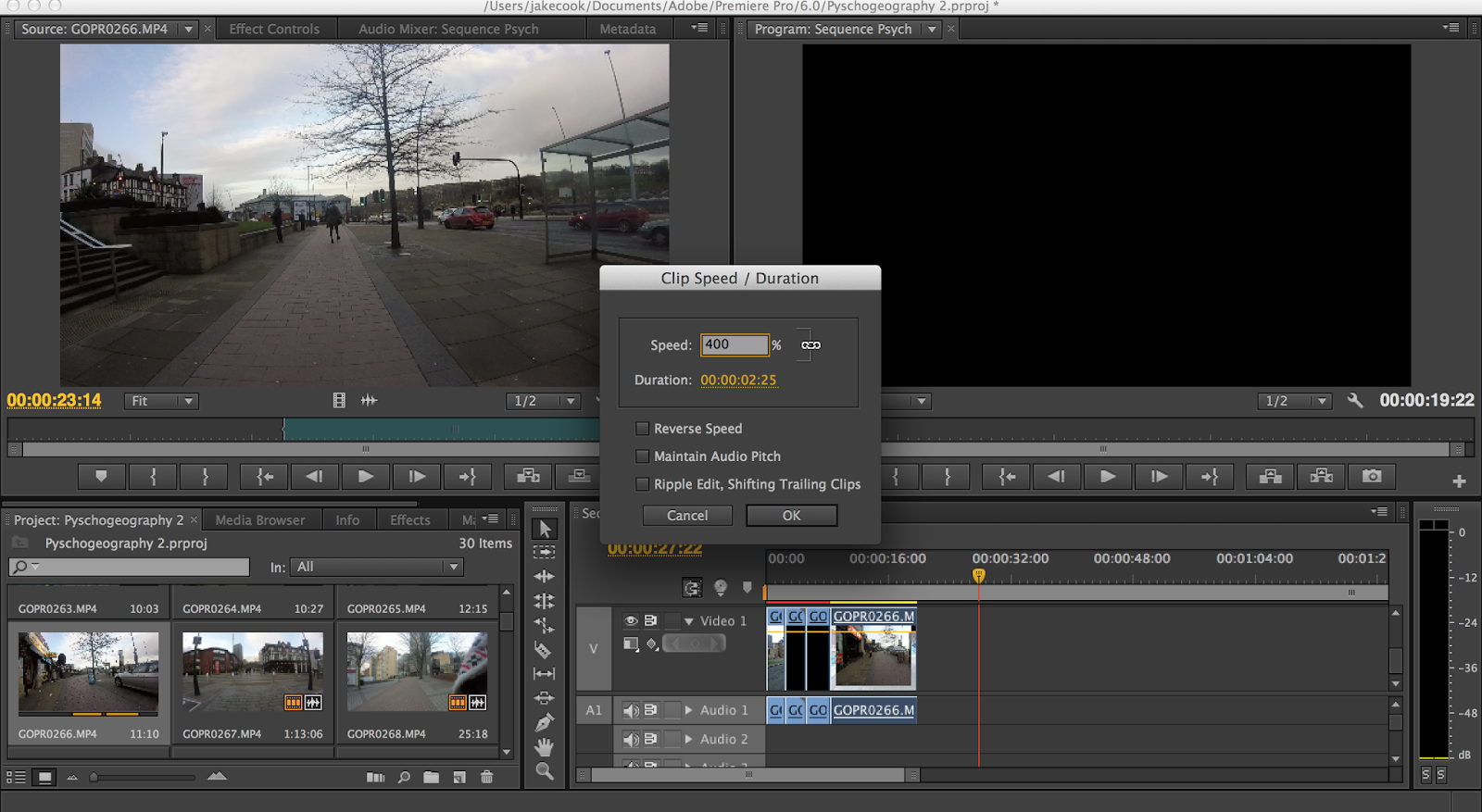
Psychogeography 2//Editing

With my first film I had a lot of help editing, but this time I 
was taught the basics of what I needed to know to put this
piece together, so I was able to do it mostly independently. 

I changed the Clip Speed from 100% to either 200%,300% or 400%,
depending on the original length of the clip, to make it faster in order to
decrease the length of the whole finished film and to make it more visually
interesting. 
After the Clip Speed had been edited, the clip next to the now shorter clip was
in the same place on the timeline so I had to 'Ripple Delete' the empty space.


A lot of the time I didn't want the whole of the clip in the final film because
they were too long, so I had to select the part of the clip I did want. To do this,
I selected where I wanted it to start by pressing 'I' (In) when viewing the clip,
then 'O' (Out) when I wanted it to end. Then I dragged the chosen piece onto
the timeline and that is what would appear in the finished piece.

I did not want audio in my piece, as that is not what I was trying to capture
and the audio on the GoPro wasn't great quality, so I had to delete this from my
clips. The audio is automatically linked to each film clip, so to delete the audio
I first had to 'unlink' it. This was done by selected all the clips on the timeline,
right clicking and selecting the 'unlink' option.

To create a fade out at the beginning and end of the finished film, I selected
the pen tool and created 2 points where I wanted the film to start fading in at
the beginning and out at the end. By dragging the yellow line across the film I
was able to change the opacity, which created a fade effect.


When I had finished editing each clip and the film was put together, I had to
render the film, which makes all the clips join together as one piece to play
through without glitching or freezing. 

Psychogeography 2//Short Film Piece


Short video piece based on my previous work on the concept of psychogeography and the way places make people feel. I took a walk around Sheffield City Centre, with very little idea of a route or where I would end up, filming short clips of my journey.
Filmed on a GoPro and edited with Adobe Premier Pro.
(The quality of the video is bad due to the small size to enable me to fit it on this post.)

Sunday, 18 January 2015

Sunday, 11 January 2015

Psychogeography//Video Piece


Video filmed on a G16 Cannon digital camera, as part of my project based on the concept of psychogeography, and the idea of how places make people feel. Filmed in Sheffield.
(Poor quality due to the video being made small enough to fit on this blog post.)

Wednesday, 26 November 2014

Print Workshop//Frankenstein Developments

On Monday we had our second workshop of the term; the print workshop. We were shown how to do monoprinting, which to me wasn't a new process because I did it a lot on my foundation course. However the workshop was useful in developing and experimenting in my Frankenstein project. The prints I produced were cityscapes/landscapes of Sheffield inspired by photos I had previously taken from Park Hill. Monoprinting is a very simple method that achieves quick pieces in a high quantity, so I have linked this with Tracey Emin's simple way of drawing and painting to express her identity, which is what I am trying to do by using Sheffield as my subject matter.

After the print workshop, I decided to incorporate Turners technique of painting the sun, light and landscape and use oil paint to work onto my prints. I have then taken the idea further and produced simple oil paintings of different sizes in the style of Turners infamous landscape paintings, but joining the cityscape of Sheffield with the landscape surrounding the city.

Monoprint using black ink on A3 paper 

Monoprint using black ink on A3 paper 

Monoprint using black ink on A3 paper 

Monoprint using black ink on A3 paper, with oil paint

Monoprint using black ink on A3 paper, with oil paint

Monoprint using brown ink on A3 paper, with oil paint

Monoprint using black ink on A3 paper, with oil paint

Oil paint on A4 paper


Oil paint on 2 halves of watercolour paper stuck together

Oil paint on 2 halves of watercolour paper stuck together


Friday, 21 November 2014

Gravity//Thomas Yeomans

This Thursdays Gravity lecture was given by a young artist called Thomas Yeomans. Having previously studied an undergraduate degree at Slade and an Ma in painting at the Royal College of Art, Yeomans now creates video pieces using preexisting footage found on the internet. Despite his current practice, he still considers himself a painter, but prefers the process of finding appropriate footage and editing it all together to become a piece of his own. During the lecture he spoke about authorship and referencing the original pieces of video he had used in his own work, he said that he didn't reference because original footage had been created into something else and was now his own. He also spoke a lot about using pre-existing footage to create his video pieces; he uses this partly because of the visual affect that can be achieved but also because he doubts his own technical ability to create something that looks good and has authenticity.

Yeomans showed a number of clips of some of his work, most of which I didn't particularly engage with, but there was one clip that was part of a longer piece that did interest me. It played wit the idea that as a society, we are far too engaged with social media and the internet; so engaged that it takes over reality and we would rather be connected with the fast moving world around us than involved simply in our own lives and what is happening in them. The next part of the clip was shots of TV advertisements from fashion, electronic and internet companies, which links with the previous idea that technology is taking over. The idea behind the video piece was extremely thought provoking and the preexisting footage that was used fit very well and looked stunning as part of the piece.

Wednesday, 12 November 2014

Course Trip to London//The Late Turner

Day two in London was by far the best day of the trip for me. Lise Autogena, Professor of Cross-Disciplinary Art at Sheffield Hallam, and one of the tutors on the trip, had organised free entry to the Late Turner and Turner Prize exhibition at the Tate Britain, an offer obviously too good to refuse. The day started extremely stressful, as me and a group of friends were forced to embark upon our first solo tube journey (including a change) to the Tate Britain after the group left earlier than we had expected. None of us were used to travelling the tube alone, and the instructions we had received on how to get there were confused and ambiguous, so we had to do a lot of guessing. But luckily with the help of a tube map and some guess work, we made it to the right tube station at the same time as the rest of the group, who guided us to the gallery. Stress over!

First, we saw the Late Turner exhibition. The exhibition included a large selection of JMW Turners paintings from the last years of his life, and showed how his creative process changed as he grew older and came to the end of his life. Turner has always been a painter who stuck out to me as one of the greatest, but after experiencing this exhibition and seeing his work in the flesh, I have become fascinated and obsessed with the sheer beauty of his paintings. The main themes through out all of Turner's work are natural light, colour, landscape and travel. He spent a large amount of time travelling Europe and painting the different landscapes and scenery where ever he was. The way Turner uses colour to create almost blurry, abstract brush strokes yet achieve fabulous detail of such fine scenery is amazing. The focus point, more often than not, is the sun and natural light spreading through nature; the sun being captured with most delicate yet bold colour. Oil paints and watercolour paints were Turner's most used medium, occasionally switching and experimenting with gouache and graphite. As I walked around the exhibition I could clearly see how his later works differentiated from his earlier paintings, they become more bold and experimental, developing further his already controversial and shocking way of working. All of Turner's paintings are so passionate and powerful, that walking around six rooms filled with his work is extremely emotive and mystifying, I came out of the exhibition feeling amazed and touched, privileged to have seen such a beautiful collection of work; exactly how I wish to be feeling when I have seen art in a gallery.

The Tate Britain

The Tate Britain

The Late Turner Exhibition

The Tate Britain

Next stop at the Tate Britain was the Turner Prize 2014 exhibition. I was not particularly overwhelmed by the four artists or their work shown in the exhibition, nothing really stood out to me as Turner Prize worthy. The exhibition is dominated by video installations, with only one textiles and print based artist.
James Richards; one piece of video art displayed in a dark room where the colour scheme was stylish grey, black and white. The video was shown on a large black, sleek TV screen with comfortable benches for the public to sit and view it from. The subject matter was ambiguous, strange pornographic, provocative images. The next part of the exhibition consisted of three slide projectors, projecting changing images of body parts being harmed or cut.
Tris Vonna-Mitchell; two selections of photographs, one with copies of repetitive poems, the other of mundane objects. There was also projections of abstract images with the audio of a man talking over the top.
Ciara Phillips; a whole room decorated with colourful prints used as the wallpaper, turning the whole room into the piece of art work.
David Campbell; before you walk into the exhibition space and you are stood reading the artist description, you hear strange recorded voices and noises, automatically triggering intrigue and thoughts about what you will see around the corner. What you see is a projected video of mainly a plain background, occasionally with patterns, doodles and shapes appearing, along with a very ambiguous piece of audio recording over the top. In the next room, a dark purple room with a bench in front of a large screen, was another video piece. This video piece involved a large number of single images and clips of historical objects, from what I would say was 1950's-2000's. Alongside the video piece was the voice narrating the objects and ideas that accompanied them. The narrative was very strange, never really reaching a point, and was hard to follow.

Tuesday, 11 November 2014

Course Trip To London//Day One

I had the most brilliant most exhausting three days in London. I have been to London more times than I can count and this was my third trip this year, but never have I seen or experienced as much as I did on this trip.

Thursday consisted of an early start, two hour train journey, dropping off our bags at the Generator Hostel (which was surprisingly pleasant for a hostel) and straight into the first gallery visit of many; Disobedient Objects at the V&A. The exhibition consisted of objects and pieces of art work designed and used in revolutions and protests. The ideas and design of some of the objects were fascinating, but as part of an exhibition the pieces were mainly unattractive and wasn't the kind of work that really appeals to me.


The next stop of the day was both galleries at the Serpentine Gallery in Kensington Gardens. In the first gallery we saw work by American artist, Trisha Donnelly. The work we saw was a mix of sculptural work and video installations. "Donnelly's work is neither abstract nor representational. Her videos oscillate and ripple, offering only suggestions of their content; the images too present only hints of the shape and reality through their many processes, occasionally betraying a subject or location." The work was very ambiguous, with the subject matter of the images being mostly unclear, but were interesting to look at as they were very 'trippy', and trigger a long thought process about the subject matter and how the videos were edited and put together. The exhibition looked good and was curated well, with artworks fitting together and working well together; for example the way the projectors were arranged so that as the public walks around the gallery shadows are cast in front of the projected videos.
In the next gallery we saw the work of Cerith Wyn Evans, which was even stranger and more ambiguous than Donnelly's work. Evans "examines the transformative 'Site/Sight/Cite' effects that light, sound and duration have on spaces and their occupants. The site of the gallery, perception of sight, the citation of references are multiple and swarming." Around the gallery there was sounds, light installations and a piece around the whole space which played with the idea of both light and duration. The piece was made of an LED light formed into a seemingly jumbled string of words that took a while to read because it spanned around the whole gallery. The gallery space was dimly lit, which allowed the light installations to be the main focus of the exhibition, and causes the public to concentrate more on the strange, yet relaxing, sounds involved in the exhibition.


Cerith Wyn Evans at the Serpentine Gallery


After the Serpentine Galleries, we walked to Richard Serra's exhibition at the Gagosian Gallery on Davies Street. The area of London we were in was clearly a very wealthy, posh part from the designer shops and expensive car dealerships we walked past, so the gallery seemed to fit in with the surrounding. We hadn't made a booking, and as the gallery was a commercial one, the gallery assistant was surprised to see such a large number of students turn up.  However she did spare a few minutes of her time to talk about Richard Serra's work, processes and the commercial art world with us. The gallery space is small, and only one, however large, drawing by Serra was displayed. Serra is a sculptor, who makes large scale, simplistic sculptures, but this drawing piece was made using paintstick on handmade paper. The drawing was a simple one, with the paper mostly covered in the dark, thick paintstick, with small amounts of the paper still showing. We were all grateful for the gallery assistant giving her time unexpectedly, however we all left the gallery in heated discussion and anger after we all felt she had been rather rude to us and treaded us as if we were stupid, naïve students. The phrase "I think you should all go and educate yourselves" was used, which left us all gobsmacked and hurt, considering we are all studying art at Sheffield Hallam to educate ourselves on the subject. Aside from that, the exhibition was interesting. The space was a very simple, stylish space, with white walls and black floor and doors, so the monochrome drawing by Serra looked right in the gallery and showed it off very well.

Richard Serra, Drawing at the Gagosian Gallery


Over all the day was extremely interesting and thought provoking, but equally tiring with the huge amount of art work and sights of London we took in in a matter of hours.