Showing posts with label Sheffield. Show all posts

Saturday, 21 March 2015

Painting Workshop//Finished Piece


This is the finished product of my 6 week painting workshop.
I am very pleased with the painting; I think the piece works well as a whole, and the colours I achieved were very successful.

Thursday, 26 February 2015

Workshop//Painting


In this weeks workshop I worked over the original figure that I started last week, but in stronger colours, with stronger emphasis on the textures and effects made by the paint. I concentrated more on mixing the right colours that will show through on the final piece, and thought a lot about which colours worked best together. I also worked a lot with which textures I could make out of the oil paint and which ones would work best on which parts of the painting. Last week was about simply marking out the figure with colours as guidelines, but this week was much more about conscious decision making.

Wednesday, 25 February 2015

Savinder Bual//Gravity 19.2.15

One of our Gravity lectures this year, where the theme is 'Time', was given by Savinder Bual. Bual has exhibited her work internationally and has lived in the UK and China. She makes pieces of video art that play with the idea of making movement out of a still image; she will manipulate still images in various ways using technology and older, more hands-on techniques to create a moving image. For example, Bual talked about how she used the manipulation of the bellow of an old fashioned camera which she had cuts slits in and inserted drawing into and moved with her hands, to create the sense of movement.


                                          'Follis Nyctanthous' by Savinder Bual 2010

Bual also talked about the 'black space' she uses in her piece, for example in 'Flicker', 'Train' and 'Wing'. This black space is a result of placing a black frame, which films are made up of, between still image frames when edited her pieces. The result is a flickering image, switching between the still image and black space. The effect that this has on Bual's work is that it forces you to use your imagination and imagine what could be in those 'empty' spaces. Forcing the viewer to use their imagination is also why Savinder uses a black and white effect in her videos; an issue raised by a member of the audience in the question time. Our work is filled with films that use colour, opening up gaps and giving all the information to the viewer, however black and white closes those gaps and allows questions to be asked.

Having moved from the UK to China and back, Savinder felt like her location and how settled she felt at the time, was fully reflected in her work. Her video of paper birds (purchased from a street seller in China) being flown into a white wall in her studios represents the 'block' she felt when she first started working over there; trying to get inspiration and creating pieces but hitting a (metaphorical) brick wall. The birds in this video had been bought, taken apart and remade in order to gain a higher understanding of the object. This technique is used a lot by Bual, she often starts with objects for inspiration for her work, with her video pieces being focused usually on mundane or handmade objects. With this as a starting point, she manipulates them to become very interesting and to have greater meaning. For example, she used the Chinese paper birds in another piece, with one being attached to a spinning ceiling fan; representing the want in people to be free and 'fly away' but our minds are constantly going, not allowing us to do this, not allowing us to live in the present.


'Flight' by Savinder Bual


 When researching Savinder outside the lecture, I found on the 'About' section of her website that she had written about her work "By discovering low-fi ways to add movement to single images and commonplace objects/materials my intent is to ignite an element of wonder at the illusion of cinema, giving the everyday enough of a twist to allow the imagination to run free." This interested me because it describes well the final video pieces that she has produced. Her videos always focus on simple, sometimes handmade objects or mundane scenes that have been manipulated. Despite this simplicity, her video pieces are made with such thought and care that they become automatically thought provoking and beautiful. 


'Flying Work 1' by Savidner Bual 2010

Objects are almost always the focus of Savinder's pieces, with her main interest being how they are made and re-making them. An interesting thought is the juxtaposition of using simple materials, like paper, and the immateriality of film making. Paper is such a basic material that is so easy to get your hands on, and can be used in so many different ways, whereas film making is a digital process where the outcome is not a solid material that can be touched or held, only watched and edited on a computer with the right technology. This is linked to how paper disappearing from the modern world and being replaced with technology like the Kindle, mobile phones and hard drives. For example, we don't use paper to make notes or to-do lists, it's easier to do that on a phone or tablet that we will have on our person most of the time. 

Savinder Bual delivered an extremely interesting lecture very well. She was engaging and sure about her ideas, with the subject of her work fitting in very well to the theme of 'time'. 

Thursday, 19 February 2015

Workshop//Painting

This week in my painting workshop I started on my large scale oil painting on canvas. It was a challenge, but I feel like it was successful as a starting point and will help me to achieve an interesting final piece.
I started off by marking out the basic shape of the figure and the background in a yellowy colour,
and then started blocking in the background.

After I had blocked in the background colour, I added the starting colours of the figure.
These aren't exactly the colours I wanted to achieve as we only had a limited range of colours, so
I will be working over/with these. 

Wednesday, 11 February 2015

Paintings//Sheffield Cityscape

During my assessment in January, I had very positive feedback about this painting. It isn't in a style I would usually use, and it is done in acrylic paints, using biro, so I didn't feel too great about it; it felt very much like the kind of work I would have produced at A-Level. However my assessment tutors told me that I should continue experimenting with this style and keep producing this kind of work, because it felt more like the kind of atmosphere of Sheffield than my other paintings did. 

I have continued to produce this kind of work, using acrylic paints and pen, of photos I have taken from Park Hill of Sheffield's cityscape. I am still not feeling that comfortable with painting in this style, it is a much longer process than other paintings I have produced, but the colours and style achieved portray a better sense of Sheffield as a city.


I have also tried using just blacks, whites and greys, and continuing to use pen.

I have also started to do pencil drawings in a similar style to the paintings, still using pen to add more detail and defined lines.


Workshop//Painting

In our second painting workshop last week, we took the collages and paintings on top of magazine pages we had made in the first week, and cut them up to create new images. We then created paintings based on the new images we made, using simple watercolour paint colours.


The next stage of the workshop will be creating large scale oil paintings based on the paintings from last week. Dale has provided us with 5 foot canvases, which we primed and prepared this week, ready to start on next week. I have never worked as large scale as this, or painted anything like this before, but I am excited to experiment, especially with oil paints.

Monday, 26 January 2015

Psychogeography 2//Editing

With my first film I had a lot of help editing, but this time I 
was taught the basics of what I needed to know to put this
piece together, so I was able to do it mostly independently. 

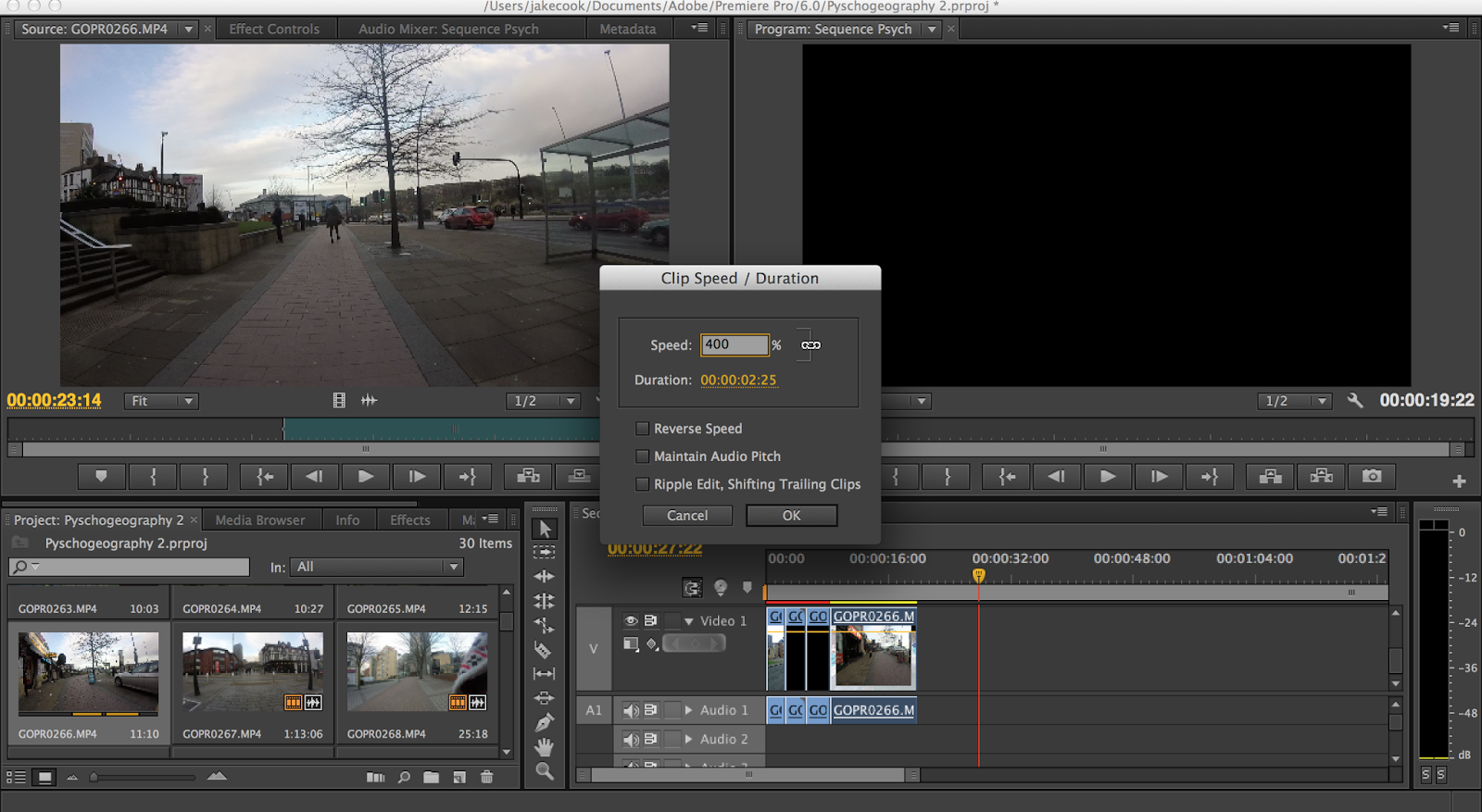
I changed the Clip Speed from 100% to either 200%,300% or 400%,
depending on the original length of the clip, to make it faster in order to
decrease the length of the whole finished film and to make it more visually
interesting. 
After the Clip Speed had been edited, the clip next to the now shorter clip was
in the same place on the timeline so I had to 'Ripple Delete' the empty space.


A lot of the time I didn't want the whole of the clip in the final film because
they were too long, so I had to select the part of the clip I did want. To do this,
I selected where I wanted it to start by pressing 'I' (In) when viewing the clip,
then 'O' (Out) when I wanted it to end. Then I dragged the chosen piece onto
the timeline and that is what would appear in the finished piece.

I did not want audio in my piece, as that is not what I was trying to capture
and the audio on the GoPro wasn't great quality, so I had to delete this from my
clips. The audio is automatically linked to each film clip, so to delete the audio
I first had to 'unlink' it. This was done by selected all the clips on the timeline,
right clicking and selecting the 'unlink' option.

To create a fade out at the beginning and end of the finished film, I selected
the pen tool and created 2 points where I wanted the film to start fading in at
the beginning and out at the end. By dragging the yellow line across the film I
was able to change the opacity, which created a fade effect.


When I had finished editing each clip and the film was put together, I had to
render the film, which makes all the clips join together as one piece to play
through without glitching or freezing. 

Psychogeography 2//Short Film Piece


Short video piece based on my previous work on the concept of psychogeography and the way places make people feel. I took a walk around Sheffield City Centre, with very little idea of a route or where I would end up, filming short clips of my journey.
Filmed on a GoPro and edited with Adobe Premier Pro.
(The quality of the video is bad due to the small size to enable me to fit it on this post.)

Sunday, 18 January 2015

Sunday, 11 January 2015

Psychogeography//Video Piece


Video filmed on a G16 Cannon digital camera, as part of my project based on the concept of psychogeography, and the idea of how places make people feel. Filmed in Sheffield.
(Poor quality due to the video being made small enough to fit on this blog post.)

Tuesday, 9 December 2014

Lens Workshop//Filming

On Sunday, I took my DSLR camera with me on a walk around Sheffield. I had no plans of a route, I just wanted to walk and not really know where I was going, my only aim was to film short clips of parts of the walk as I was walking. With the footage I took, I then wanted to put all the footage together and speed it up to show the journey all together. However when I got back and looked at the footage, it was very blurry and jumpy from where it had captured my movements. I was very disappointed with the result, but on Monday we had our last workshop, the lens workshop. In this, I was able to find out what would be a better way to capture the footage I wanted to, in a smoother way without capturing too much of my walking movements. I have borrowed a G16 Canon digital camera from the university Creative Media Centre, so today I went on another walk around the city and this time used this to record my journey. This footage has turned out a lot better than before, as the camera is a lot more lightweight and easier to handle, it has captured the walk a lot more smoothly and in the way I wanted it to. I plan on editing the footage together very soon, and taking a lot more journeys around different parts of Sheffield and creating maps to go with each one.

On my first journey, I did however get to take some pictures of the city, as the sky was very crisp and blue that day, making very good lighting conditions.


More Landscapes//Gouache Paintings

I recently ran out of oil paints, so when I took a trip to the Works (cheap, I know) I was planning on buying more of the same paints I had been using. However, the oil paints were out of stock, so I came away with a set of Gouache paints. I have never used Gouache before so decided to take it on as a bit of a challenge and experiment. I also bought a pack of canvas board, and two landscape canvas', the quality of which isn't very high, but simply for experimenting on they are good enough for me.

I have now used the Gouache paints on the A5 canvas board, which has produced some painting which I quite like. The Gouache dries very quickly, making it harder to blend, but if you blend quick enough whilst they are still wet it produces a very satisfying effect. I like the colours and textures that can be achieved with this paint, and the sun and light in the paintings are very strong, which is what I wanted to achieve.


Friday, 5 December 2014

Psychogeography//The Situationist International; A User's Guide

I am very interested in where people have lived in their lives, how these places have influenced their identity and where people call home. When discussing this and my ideas for a project based on these ideas with my tutor Andrew Sneddon a few weeks ago, he suggested looking into the concept 'psychogeography'. I had never heard of the term, but I took his advice and have done a lot of research on the idea, and have found that it does link very well with my ideas. He sent me a number of pieces of writing about psychogeography and nostalgia which I have read briefly, and lent me the film 'Patience: After Sebald' based on the book Rings of Saturn by Sebald. This material has been very useful to me as I have learnt a lot about psychogeography and how places influence people so strongly. I plan on reading the Rings of Saturn as well to fully understand Sebald's ideas and get a better picture of the journey he takes and places he visits.

I have also read the majority of 'The Situationist International; A User's Guide' by Simon Ford, which talks about the art movement put together by Debord, Jorn, Constant and Bernstein in Paris in the twentieth century. The movement describes psychogeography as 'the study of the specific effects of the geographical environment, consciously organised or not, on the emotions and behaviour of individuals.'

I am very keen on looking further into this idea and basing a project strongly around it. I have sent questions to family members and friends concerning their ideas about where home is and how places they have lived in have affected their emotions and identity, and I plan on using photography and video to present the answers and thoughts given about these questions. I have also started to film my journeys by foot around Sheffield on my iPhone, and I plan on putting all these clips together and speeding them up to make a short film piece about Sheffield.

Wednesday, 26 November 2014

Print Workshop//Frankenstein Developments

On Monday we had our second workshop of the term; the print workshop. We were shown how to do monoprinting, which to me wasn't a new process because I did it a lot on my foundation course. However the workshop was useful in developing and experimenting in my Frankenstein project. The prints I produced were cityscapes/landscapes of Sheffield inspired by photos I had previously taken from Park Hill. Monoprinting is a very simple method that achieves quick pieces in a high quantity, so I have linked this with Tracey Emin's simple way of drawing and painting to express her identity, which is what I am trying to do by using Sheffield as my subject matter.

After the print workshop, I decided to incorporate Turners technique of painting the sun, light and landscape and use oil paint to work onto my prints. I have then taken the idea further and produced simple oil paintings of different sizes in the style of Turners infamous landscape paintings, but joining the cityscape of Sheffield with the landscape surrounding the city.

Monoprint using black ink on A3 paper 

Monoprint using black ink on A3 paper 

Monoprint using black ink on A3 paper 

Monoprint using black ink on A3 paper, with oil paint

Monoprint using black ink on A3 paper, with oil paint

Monoprint using brown ink on A3 paper, with oil paint

Monoprint using black ink on A3 paper, with oil paint

Oil paint on A4 paper


Oil paint on 2 halves of watercolour paper stuck together

Oil paint on 2 halves of watercolour paper stuck together


Monday, 3 November 2014

Gravity//David Clegg

David Clegg is an artist who visits care homes collecting life stories from dementia patients. His project, The Trebus Project, was named after Polish war veteran, Edmund Trebus, who fills his house with artefacts that have been deemed 'rubbish'. In a way Clegg does the same thing, making his work out of the stories of dementia patients that have been forgotten about and misunderstood because of their condition. The project started when Clegg decided after his degree and a life of wanting to be an artist, that he no longer wanted to be one ("I don't like artists"), so decided to work in a care home. He gradually started working with dementia patients and building up life stories from their confused and jumbled memories; some of which turned out to be quite amazing.

The Gravity lecture David Clegg gave us turned out to be my favourite of the lectures we have had so far, as Clegg was a brilliant speaker, who spoke to his audience with great confidence rather than from a script as many of the other visiting artists have. He had some beautiful stories and ideas that he shared very well. With the theme of Gravity this year being 'Time', Clegg's subject matter fitted in brilliantly, with his work being based of time, memories and loss.

David Clegg made the point many times throughout the lecture that he is not an art therapist. He is however an artist that uses patients' stories to make art rather than using therapy to help his patients. Clegg has worked with so many patients and has gained so many skills and so much knowledge concerned with dementia, that he now teaches nurses and care workers how to communicate with and listen to people with dementia. He has worked with a huge variety of patients, some with extraordinary stories, and some who have lived average lives as housewives or handymen. Clegg has also happened to record the last words of elderly patients and has been with them right up until their death. A great interest of his is language and how language changes with the condition, and how this affects their ability to make sense of memories and put the fragmented parts of memory together.

A discussion in one of my groups that was raised by this subject was the question of whether Clegg publishing life stories of ill elderly people is ethically correct, considering the condition of the patients he was working with. Some students believed that because the patients may not have been aware of what they would have been consenting to at the time. So is it right that he published their stories if they are unable to consent? This also leads to the question of the boundaries in art. A lot of artists make art to shock and go to extreme lengths to capture a shocking subject that may push and question boundaries, something I don't think David Clegg does.

I think Clegg's work is beautiful and genius in it's own way; it raises intellectual questions and reveals extraordinary stories. He doesn't push ridiculous questions and lets the work be understood by the less creative public; something I believe to be very important.

Thursday, 30 October 2014

Shadow Clock//Hagglers Corner

Poet and family friend, Mark Goodwin
 
Nick Bullock
 
Last Saturday, 25th of October, I attended a literary event based on time, appropriate because that was the night the clocks went back an hour, at a very interesting venue on Queens Road in Sheffield, Haggler's Corner. My family and I were invited to the event because family friend and poet, Mark Goodwin, was one of the speakers, reading his own poetry based on the theme of the event.

The event involved a variety of novelists, writers and poets who all beautifully read their own pieces in the confines of the gallery which is part of Haggler's Corner. It was a cold evening, so sitting in the warmth on a comfy sofa with a cup of tea from the cafĂ© made the whole experience very enjoyable. Some beautiful pieces were read by some great voices, and being a big fan of Mark Goodwin's poetry made his reading the highlight of my evening. Another reader that was very successful was climber, explorer and writer Nick Bullock. He is a very interesting character who swears a lot and has a great sense of humour, but read some wonderful and very deep, and sometimes quite depressing, pieces he has written about his adventures and experiences.

Thursday, 23 October 2014

Nostalgia//A Common Theme

Throughout many of the lectures and Crit groups I have attended in the past few weeks, I have noticed that nostalgia and melancholy in art work have been a recurring theme/debate. During our first Gravity lecture, where the theme this year is time, one point that was made by my Crit tutor Andrew Sneddon really stood out to me. He first talked about how in old medicine they taught that melancholia was a physical sickness caused by an imbalance of black bile, yellow bile phlegm or blood, which is what caused soldiers to suffer from homesickness etc. Obviously as time and medicine has progressed we know this isn't true. However, Andrew to some extent believes this is how we should melancholy and nostalgia, and as contemporary artists we should not use nostalgia in our practice, but we should be thinking more progressively. 

Melancholy is given the definition "a gloomy state of mind, especially when habitual or prolonged; depression; sober thoughtfulness; pensiveness. Nostalgia is given the definition "a wistful desire to return in thought or in fact to a former time in one's life, to one's homeland, or to one's family and friends; a sentimental yearning for the happiness of a former place or time." As we can see, both melancholy and nostalgia have deep emotional meanings. In the self set drawing project that we are talking about and starting imminently, I am looking at basing drawings on a past and present relationship I have with Sheffield. Having spent four years of my childhood living half an hour up the road, I feel like those years were a massive part of my life and have so many memories here. Without this nostalgia I wouldn't have the inspiration I do for this project. Memories and our past create who we are, and as artist we are forever being encouraged to use our sense of self. So surely to do this we must use nostalgia? 

However, part of me does agree with the point Andrew and many other contemporary artists have made, I don't think we should use emotions too strongly or let them too deeply affect our work, and as a Creative Art Practice student, I think it's perfectly okay to create a piece of work just because it looks good, but surely nostalgia gives us inspiration and feelings towards our work? I think for a piece to work for us we have to have a relationship with it, which in a huge way I believe is created by memories and nostalgia. 

The Move to S1

Almost five weeks ago now, I made the big move from my home in Leicestershire to my student accommodation in Sheffield, after a wait that felt like forever. I finished my foundation degree at the end of May this year, and have known about my unconditional place at Sheffield Hallam since February, so I was very excited for the move and new start for a very long time.
Since being here I have experienced freshers week (which inevitably came hand in hand with 'freshers flu'!), met lots of lovely new people, had a lot of fun learning to cook and live independently  with my great flat mates and got to know an amazing city. I have also been introduced to my course (Creative Art Practice), with Streams groups, drawing exercises, Crit groups, lectures and the visiting artist programs Gravity and Transmission.
The lecturers and tutors I have been introduced to have been great and I am looking forward to progressing on the course and taking a trip to London in two weeks time to aid our research!
Exploring the city; Sheffield Town Hall
Exploring the city; Street Art

My new room

Bathroom drawing exercise

Drawing from memory exercise