Showing posts with label Creative Art Practice. Show all posts

Saturday, 21 March 2015

Painting Workshop//Finished Piece


This is the finished product of my 6 week painting workshop.
I am very pleased with the painting; I think the piece works well as a whole, and the colours I achieved were very successful.

Thursday, 26 February 2015

Workshop//Painting


In this weeks workshop I worked over the original figure that I started last week, but in stronger colours, with stronger emphasis on the textures and effects made by the paint. I concentrated more on mixing the right colours that will show through on the final piece, and thought a lot about which colours worked best together. I also worked a lot with which textures I could make out of the oil paint and which ones would work best on which parts of the painting. Last week was about simply marking out the figure with colours as guidelines, but this week was much more about conscious decision making.

Thursday, 19 February 2015

Workshop//Painting

This week in my painting workshop I started on my large scale oil painting on canvas. It was a challenge, but I feel like it was successful as a starting point and will help me to achieve an interesting final piece.
I started off by marking out the basic shape of the figure and the background in a yellowy colour,
and then started blocking in the background.

After I had blocked in the background colour, I added the starting colours of the figure.
These aren't exactly the colours I wanted to achieve as we only had a limited range of colours, so
I will be working over/with these. 

Wednesday, 11 February 2015

Paintings//Sheffield Cityscape

During my assessment in January, I had very positive feedback about this painting. It isn't in a style I would usually use, and it is done in acrylic paints, using biro, so I didn't feel too great about it; it felt very much like the kind of work I would have produced at A-Level. However my assessment tutors told me that I should continue experimenting with this style and keep producing this kind of work, because it felt more like the kind of atmosphere of Sheffield than my other paintings did. 

I have continued to produce this kind of work, using acrylic paints and pen, of photos I have taken from Park Hill of Sheffield's cityscape. I am still not feeling that comfortable with painting in this style, it is a much longer process than other paintings I have produced, but the colours and style achieved portray a better sense of Sheffield as a city.


I have also tried using just blacks, whites and greys, and continuing to use pen.

I have also started to do pencil drawings in a similar style to the paintings, still using pen to add more detail and defined lines.


Workshop//Painting

In our second painting workshop last week, we took the collages and paintings on top of magazine pages we had made in the first week, and cut them up to create new images. We then created paintings based on the new images we made, using simple watercolour paint colours.


The next stage of the workshop will be creating large scale oil paintings based on the paintings from last week. Dale has provided us with 5 foot canvases, which we primed and prepared this week, ready to start on next week. I have never worked as large scale as this, or painted anything like this before, but I am excited to experiment, especially with oil paints.

Monday, 26 January 2015

Workshop//Painting

Today saw the start of our third workshop series. After my assessment earlier this month, it was suggested to me to take part in the Figurative Painting workshop run by Dale Holmes. This was because my assessment tutors thought I should branch out and explore different ways of painting and expand my knowledge of the subject.

During the first workshop, we discussed the importance of contemporary and figurative painters in the art world today, and discussed how 'good' paintings are made. Throughout the workshop series we will be learning about techniques and components that make a successful figurative painting, and creating paintings of our own. As a starter activity we made collages from magazine cut-outs, layering up backgrounds, foregrounds and figures to explore how paintings are put together. We then used paint to work onto magazine pages to break down the simple shapes used within an image, to think about how shapes are used to create a painting. 


Psychogeography 2//Editing

With my first film I had a lot of help editing, but this time I 
was taught the basics of what I needed to know to put this
piece together, so I was able to do it mostly independently. 
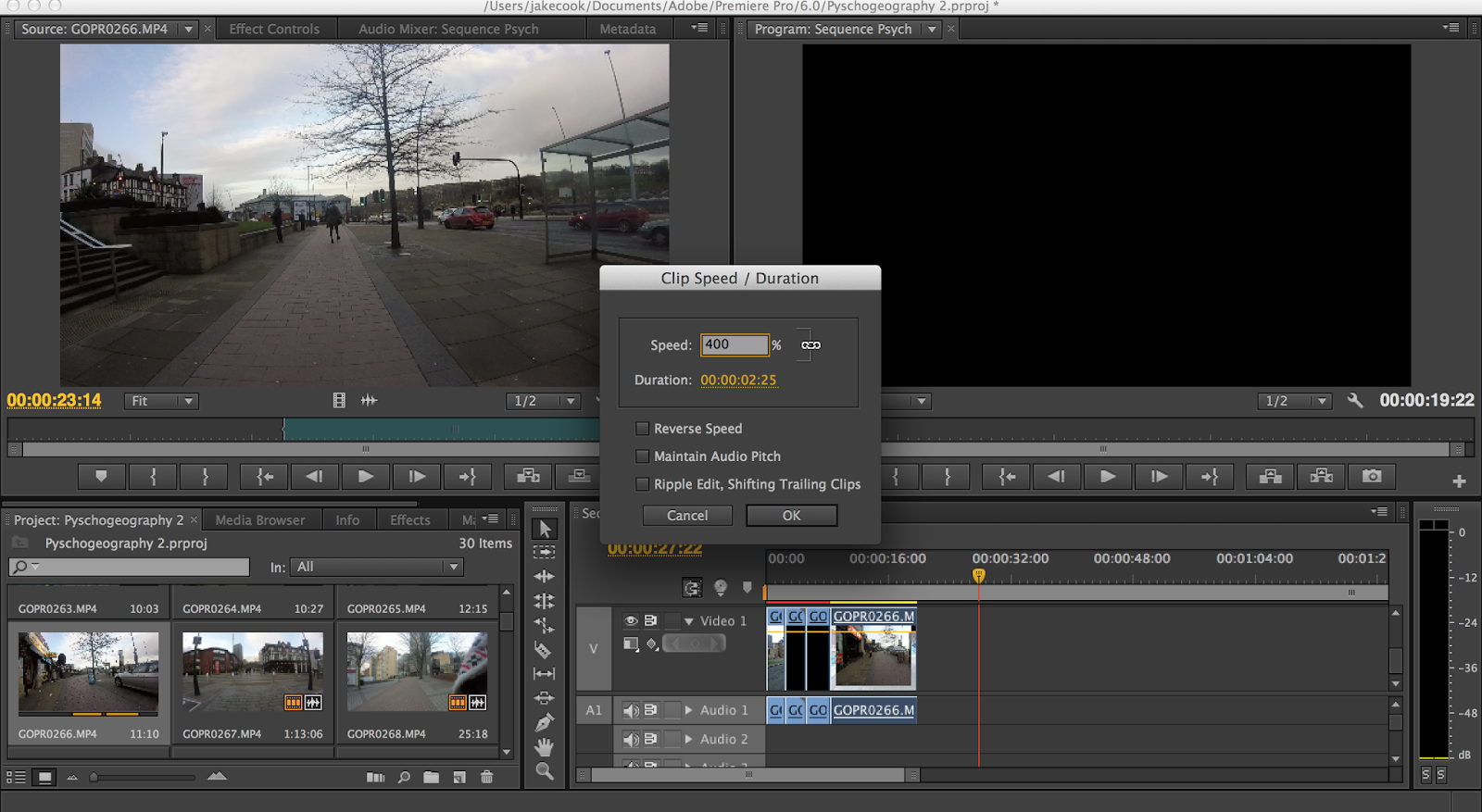
I changed the Clip Speed from 100% to either 200%,300% or 400%,
depending on the original length of the clip, to make it faster in order to
decrease the length of the whole finished film and to make it more visually
interesting. 
After the Clip Speed had been edited, the clip next to the now shorter clip was
in the same place on the timeline so I had to 'Ripple Delete' the empty space.


A lot of the time I didn't want the whole of the clip in the final film because
they were too long, so I had to select the part of the clip I did want. To do this,
I selected where I wanted it to start by pressing 'I' (In) when viewing the clip,
then 'O' (Out) when I wanted it to end. Then I dragged the chosen piece onto
the timeline and that is what would appear in the finished piece.

I did not want audio in my piece, as that is not what I was trying to capture
and the audio on the GoPro wasn't great quality, so I had to delete this from my
clips. The audio is automatically linked to each film clip, so to delete the audio
I first had to 'unlink' it. This was done by selected all the clips on the timeline,
right clicking and selecting the 'unlink' option.

To create a fade out at the beginning and end of the finished film, I selected
the pen tool and created 2 points where I wanted the film to start fading in at
the beginning and out at the end. By dragging the yellow line across the film I
was able to change the opacity, which created a fade effect.


When I had finished editing each clip and the film was put together, I had to
render the film, which makes all the clips join together as one piece to play
through without glitching or freezing. 

Psychogeography 2//Short Film Piece


Short video piece based on my previous work on the concept of psychogeography and the way places make people feel. I took a walk around Sheffield City Centre, with very little idea of a route or where I would end up, filming short clips of my journey.
Filmed on a GoPro and edited with Adobe Premier Pro.
(The quality of the video is bad due to the small size to enable me to fit it on this post.)

Sunday, 18 January 2015

Sunday, 11 January 2015

Psychogeography//Video Piece


Video filmed on a G16 Cannon digital camera, as part of my project based on the concept of psychogeography, and the idea of how places make people feel. Filmed in Sheffield.
(Poor quality due to the video being made small enough to fit on this blog post.)

Tuesday, 9 December 2014

More Landscapes//Gouache Paintings

I recently ran out of oil paints, so when I took a trip to the Works (cheap, I know) I was planning on buying more of the same paints I had been using. However, the oil paints were out of stock, so I came away with a set of Gouache paints. I have never used Gouache before so decided to take it on as a bit of a challenge and experiment. I also bought a pack of canvas board, and two landscape canvas', the quality of which isn't very high, but simply for experimenting on they are good enough for me.

I have now used the Gouache paints on the A5 canvas board, which has produced some painting which I quite like. The Gouache dries very quickly, making it harder to blend, but if you blend quick enough whilst they are still wet it produces a very satisfying effect. I like the colours and textures that can be achieved with this paint, and the sun and light in the paintings are very strong, which is what I wanted to achieve.


Friday, 5 December 2014

Psychogeography//The Situationist International; A User's Guide

I am very interested in where people have lived in their lives, how these places have influenced their identity and where people call home. When discussing this and my ideas for a project based on these ideas with my tutor Andrew Sneddon a few weeks ago, he suggested looking into the concept 'psychogeography'. I had never heard of the term, but I took his advice and have done a lot of research on the idea, and have found that it does link very well with my ideas. He sent me a number of pieces of writing about psychogeography and nostalgia which I have read briefly, and lent me the film 'Patience: After Sebald' based on the book Rings of Saturn by Sebald. This material has been very useful to me as I have learnt a lot about psychogeography and how places influence people so strongly. I plan on reading the Rings of Saturn as well to fully understand Sebald's ideas and get a better picture of the journey he takes and places he visits.

I have also read the majority of 'The Situationist International; A User's Guide' by Simon Ford, which talks about the art movement put together by Debord, Jorn, Constant and Bernstein in Paris in the twentieth century. The movement describes psychogeography as 'the study of the specific effects of the geographical environment, consciously organised or not, on the emotions and behaviour of individuals.'

I am very keen on looking further into this idea and basing a project strongly around it. I have sent questions to family members and friends concerning their ideas about where home is and how places they have lived in have affected their emotions and identity, and I plan on using photography and video to present the answers and thoughts given about these questions. I have also started to film my journeys by foot around Sheffield on my iPhone, and I plan on putting all these clips together and speeding them up to make a short film piece about Sheffield.

Wednesday, 26 November 2014

Print Workshop//Frankenstein Developments

On Monday we had our second workshop of the term; the print workshop. We were shown how to do monoprinting, which to me wasn't a new process because I did it a lot on my foundation course. However the workshop was useful in developing and experimenting in my Frankenstein project. The prints I produced were cityscapes/landscapes of Sheffield inspired by photos I had previously taken from Park Hill. Monoprinting is a very simple method that achieves quick pieces in a high quantity, so I have linked this with Tracey Emin's simple way of drawing and painting to express her identity, which is what I am trying to do by using Sheffield as my subject matter.

After the print workshop, I decided to incorporate Turners technique of painting the sun, light and landscape and use oil paint to work onto my prints. I have then taken the idea further and produced simple oil paintings of different sizes in the style of Turners infamous landscape paintings, but joining the cityscape of Sheffield with the landscape surrounding the city.

Monoprint using black ink on A3 paper 

Monoprint using black ink on A3 paper 

Monoprint using black ink on A3 paper 

Monoprint using black ink on A3 paper, with oil paint

Monoprint using black ink on A3 paper, with oil paint

Monoprint using brown ink on A3 paper, with oil paint

Monoprint using black ink on A3 paper, with oil paint

Oil paint on A4 paper


Oil paint on 2 halves of watercolour paper stuck together

Oil paint on 2 halves of watercolour paper stuck together


Friday, 21 November 2014

Gravity//Thomas Yeomans

This Thursdays Gravity lecture was given by a young artist called Thomas Yeomans. Having previously studied an undergraduate degree at Slade and an Ma in painting at the Royal College of Art, Yeomans now creates video pieces using preexisting footage found on the internet. Despite his current practice, he still considers himself a painter, but prefers the process of finding appropriate footage and editing it all together to become a piece of his own. During the lecture he spoke about authorship and referencing the original pieces of video he had used in his own work, he said that he didn't reference because original footage had been created into something else and was now his own. He also spoke a lot about using pre-existing footage to create his video pieces; he uses this partly because of the visual affect that can be achieved but also because he doubts his own technical ability to create something that looks good and has authenticity.

Yeomans showed a number of clips of some of his work, most of which I didn't particularly engage with, but there was one clip that was part of a longer piece that did interest me. It played wit the idea that as a society, we are far too engaged with social media and the internet; so engaged that it takes over reality and we would rather be connected with the fast moving world around us than involved simply in our own lives and what is happening in them. The next part of the clip was shots of TV advertisements from fashion, electronic and internet companies, which links with the previous idea that technology is taking over. The idea behind the video piece was extremely thought provoking and the preexisting footage that was used fit very well and looked stunning as part of the piece.

Monday, 17 November 2014

Frankenstein Project//London

The project we have been set to complete during November is based on art work and exhibitions we saw in London. The idea is to take ideas, inspiration and techniques from artists and pieces of art work that we liked from our trip. My favourite exhibitions were the Late Turner at the Tate Britain and Tracey Emin at the White Cube gallery, so since we returned I have been thinking of ways I can combine these two very different artists and creative processes to produce a piece at the end of the project.

I have decided to use the subject matter and techniques seen in Turners late work, with strong colour, light, nature and landscape, combined with Tracey Emin's ideas of identity and self-acceptance. I am going to use photos I have taken from Park Hill in Sheffield over looking the city and paint in the style of JMW Turner using both watercolour, acrylic and oil paints to experiment with the effects the different paints have on the colours and light produced. I will use this location to link with Tracey Emin's idea of identity that is shown in a lot of her work. Having just moved to Sheffield and started to settle in and discover a new life here, I feel it is a big part of my identity, so it is only appropriate to use in this project. This also links to the other drawing project I will be working on where I am working with memories, nostalgia and identity.

Today we had a painting workshop as part of the next step of our course. We experimented with oil paints, painting on primed paper and MDF board, using turpentine to experiment with using thick and thin paint. The workshop was very helpful in decided what to do for the Frankenstein project and where to take it. I used to paint a lot during A-Levels and my Art Foundation, but since moving to Sheffield and not having much time or space to paint I haven't painted nearly as much as I would have liked; so this workshop has definitely inspired me to keep painting and mainly use painting in this project.
Park Hill

Primed MDF board and paper

Charcoal drawings to mark out subject matter before painting

Palette with mixed oil paints

Oil paint thinned out with turpentine on paper

Oil paint applied thickly to MDF board
Another artist that I am going to try and incorporate into my project is Frank Auerbach, who's work we saw at the Tate Britain. Auerbach paints with oil paints applied extremely thickly to a surface to create a fascinating texture. I love the thickness of the paint and the texture created by this technique, and I love oil paint so I would love to create a piece like his.

Auerbach